Showing posts with label Komodo Island. Show all posts

Wednesday, 19 January 2011

Komodo Island

3 Reasons to visit the Komodo Island
The Komodo Island is a reasonably small island and has a population of just over 2000 people. Despite this relatively intimate setting, the locals are very welcoming and there are a number of activities to entertain tourist. Below are just some of the things that you could do on trip to the Komodo Island.

Wildlife - The Komodo Dragons are famous world wide as they are the last remaining animals of their type left on earth. The giant lizards grow up to 4 metres in length and are a huge draw for tourists due to the fact that they have remained unchanged for millions of years. By watching Komodo Dragons you can actually gain an insight into what wildlife was like in ancient times.

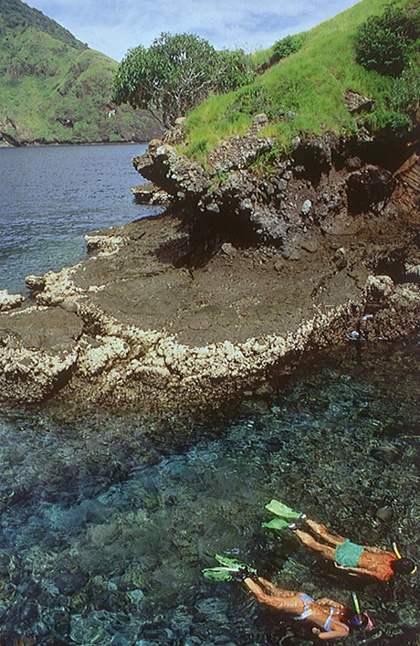
Sea life - The Komodo Island is surrounded by glorious ocean. You can either go on boat trips to enjoy the scenery and crystal clear waters, or go snorkelling and experience the sea life which is so rich and assorted. The shallow reefs in particular offer a splendid experience which will never be forgotten. By venturing further out into deeper waters you will be able to view the variety of large fish which patrol the waters.

Beaches - The beaches on Komodo Island are sandy and exquisite. The so called pink beach, with its red sands and glorious scenery is one of the most popular beaches on the island. Visiting these beaches provides all the hallmarks of a luxury break.
(Source :http://www.tourismindonesia.com/search/label/Komodo)



Friday, 19 November 2010

Komodo National Park


Komodo National Park is located in the center of the Indonesian archipelago, between the islands of Sumbawa and Flores. Established in 1980, initially the main purpose of the Park was to conserve the unique Komodo dragon (Varanus komodoensis) and its habitat. However, over the years, the goals for the Park have expanded to protecting its entire biodiversity, both terrestrial and marine. In 1986, the Park was declared a World Heritage Site and a Man and Biosphere Reserve by UNESCO, both indications of the Park's biological importance.

Komodo National Park includes three major islands: Komodo, Rinca and Padar, as well as numerous smaller islands creating a total surface area (marine and land) of 1817km (proposed extensions would bring the total surface area up to 2,321km2). As well as being home to the Komodo dragon, the Park provides refuge for many other notable terrestrial species such as the orange-footed scrub fowl, an endemic rat, and the Timor deer. Moreover, the Park includes one of the richest marine environments including coral reefs, mangroves, seagrass beds, seamounts, and semi-enclosed bays. These habitats harbor more than 1,000 species of fish, some 260 species of reef-building coral, and 70 species of sponges. Dugong, sharks, manta rays, at least 14 species of whales, dolphins, and sea turtles also make Komodo National Park their home.

Threats to terrestrial biodiversity include the increasing pressure on forest cover and water resources as the local human population has increased 800% over the past 60 years. In addition, the Timor deer population, the preferred prey source for the endangered Komodo dragon, is still being poached. Destructive fishing practices such as dynamite-, cyanide, and compressor fishing severely threaten the Park's marine resources by destroying both the habitat (coral reefs) and the resource itself (fish and invertebrate stocks). The present situation in the Park is characterized by reduced but continuing destructive fishing practices primarily by immigrant fishers, and high pressure on demersal stocks like lobsters, shellfish, groupers and napoleon wrasse. Pollution inputs, ranging from raw sewage to chemicals, are increasing and may pose a major threat in the future.

Source : http://www.komodonationalpark.org/